
An interactive discovery tool · $90
Sharp Questions
The discovery questions that get past the symptoms to the real problem, on every call you take.
Your next discovery call is in an hour. You already half-know how it goes: you’ll learn the symptoms, not the real problem, and write the proposal a little blind. This is the file you open instead. It hands you the questions that make a client pause, look up, and say “nobody’s ever asked me that.” That’s the moment they start trusting you.
You hear the symptoms and miss the problem
Minute 25 of your usual discovery call. You have a page of notes, and every line on it is a symptom.
They tell you they “need a rebrand,” but what they really need is to figure out why deals are falling apart. You didn’t dig. They didn’t volunteer. Now you’re writing a proposal for the wrong thing.
There’s no workshop. No homework. No sticky notes.
There’s one file you open on every call. It hands you the right questions, tells you whether the client is ready to move, and saves each prospect as its own record, right there on your own machine. You run it live, while you’re talking.
One tool you run every call
- Two editions, one tool. The first time you open it, you tell it whether your client sells services or sells a product. Every question then retunes to how that kind of business makes money. A services client gets asked about utilization, scope creep, and the people the work quietly depends on. A product client gets asked about margin after returns, dead inventory, and the sales channel that could vanish overnight. You pick once, and it remembers.
- The interactive tool. A single file that opens in any browser, works offline, and keeps everything you type on your own machine. A live call sheet during the call, a fit score that does the math after, a debrief, and a reference you can search. Nothing to install, no account, no data leaving your laptop.
- 40-plus discovery questions, in 4 parts. Every one comes with why it matters, what a good answer sounds like, the answer that should worry you, the hidden tell it’s really there to surface, and what to listen for. Several I pulled from the messaging interview I run, the kind that gets founders to say things they’ve never said out loud.
- A fit score that decides for you. Six dimensions, scored 1 to 5. It totals them live and gives you the verdict: take it, talk conditions, or walk. No more proposing to clients who were never going to move.
- A walk-away checklist. Ten signs an engagement will probably blow up, counted as you check them. One is a conversation starter. Three is your answer: no.
- A printable companion, too. The whole library as a clean, premium PDF, one for each edition, to read once or keep on the shelf next to the tool.
A few of the actual questions
- “What’s the one thing about this you’re hoping I won’t ask about?”
- “What would happen to the business if you took four weeks off?”
- “Who’s going to defend this when it gets hard, and who are they defending against?”
Nobody walks in with a rehearsed answer to those. That’s the point. The question they’ve never been asked is the one that gets them to trust you, and every question in here is built to land like that.
Clients on the discovery method this is built from
- “Lee is great at asking the right questions, and the more he knows, the more value he brings.”
Jennifer Carrillo, Director of Operations - “A standout was filling out his pre-project survey. A fun, unique, and creative way for Lee to understand our goals.”
Autumn Morgan, Planet Argon - “Take his onboarding survey seriously. It’s crucial to be honest and thoughtful.”
Andy Ballester, EyePop.ai
A look inside the tool
Not a mockup. The live call sheet, and one question with its decoder pane open. Most questions are blurred in these previews. You get every one, sharp, the moment you buy.
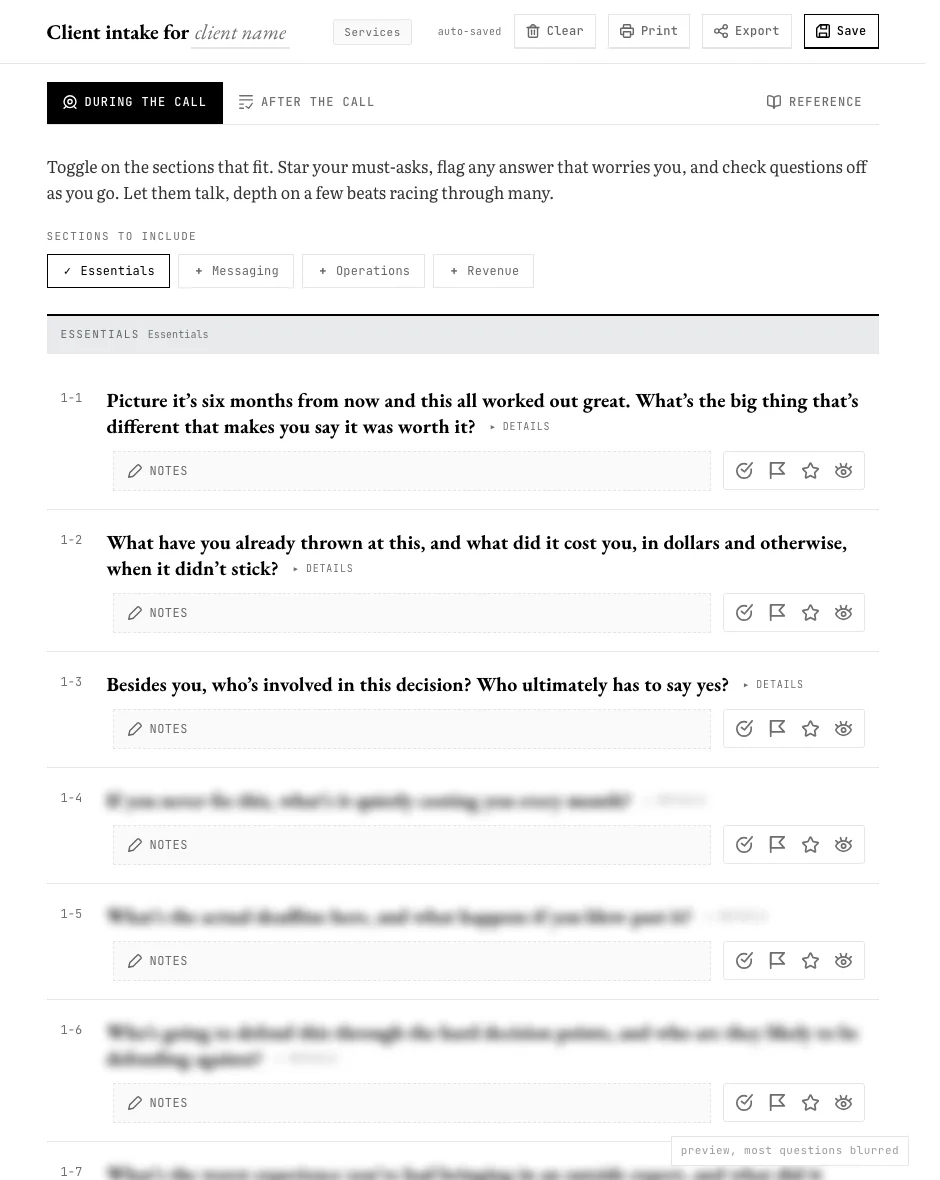
The call sheet you run live: toggle the sections that fit, take notes, flag and star as you go.
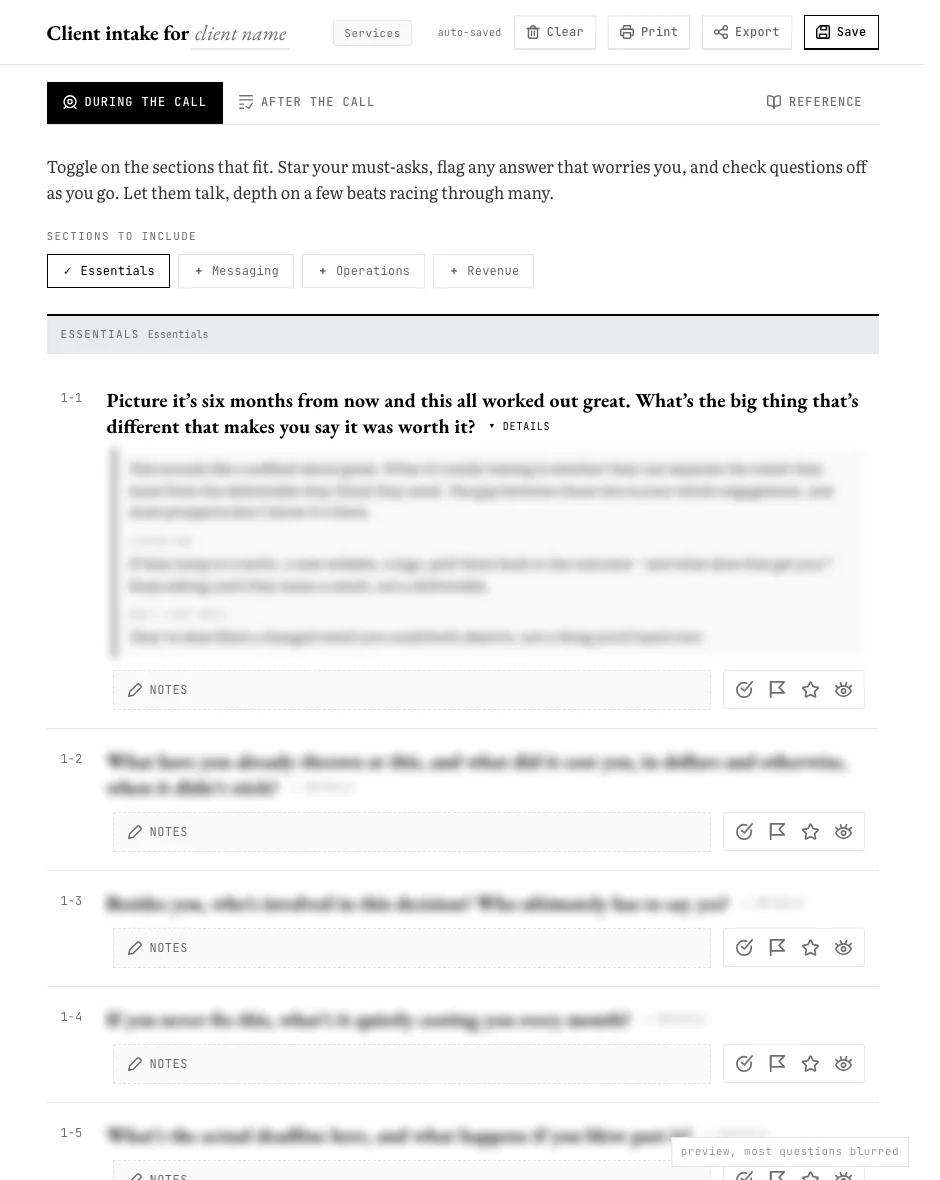
Every question hides a decoder pane: the tell it surfaces, what to listen for, and where to land it.
The four parts
- 01Essentials · 8 questions. Ask these on every call, whatever your client sells. They reveal the gap between their diagnosis and reality.
- 02Messaging & positioning · 8 questions. The villain, the dream, the headline. The ones that get a founder to say something true.
- 03Operations & workflow · 13 questions. Use when the problem is internal: chaos, bottlenecks, the owner who’s too busy. Retunes by edition, utilization and delivery for services, inventory and fulfillment for product.
- 04Revenue & growth · 11 to 12 questions. Use when the engagement is about pipeline, pricing, or sales process. Retunes by edition, proposals and close rate for services, conversion, margin, and repeat purchase for product.
One file, every prospect
Here’s how I use it. One master file. Before a call, I copy it and rename the copy for the client. During the call I’m on the call sheet: I pull the sections that fit, check off what I asked, flag the answers that worry me, and jot what they said. I go deep on eight or ten questions, not a thin pass over all forty.
After, you score the fit and it tells you straight: take it, eyes open, or walk. Then ten minutes on the debrief, while it’s fresh. Save the call as its own file, your record of that prospect, or export it to drop straight into Claude and draft the proposal.
Built for people who dig
You’re running an agency, a consulting practice, or a fractional role. You’re tired of proposals that miss the mark because you misunderstood the scope. You want to ask smarter questions and close faster. You want clients to know they’ve been genuinely heard, not processed.
You’re not an order-taker. You ask questions. You dig. You’re not afraid to walk away from a bad fit.
And yes, you could wing it. You probably have. It works right up until the call where it doesn’t, and one bad-fit engagement, the kind you take because you misread the room, costs you a lot more than $90 and a couple of weekends.
- Not for you if you’re comfortable going into calls without a structure.
- Skip it if you’re happy with your current close rate and client quality.
- Reconsider if you think the problem is usually what the client says it is the first time they describe it. This isn’t built for that.
Ready?
Buy it once, run it on every call you ever take, and watch what happens when you ask the right questions.
Walk away from one engagement that would have gone sideways and it has paid for itself many times over.
Checkout didn’t open. Try again, or email me at [email protected].
Run it on a real discovery call. If no prospect ever stops to say “huh, good question,” email me, I’ll refund every cent, no forms, and you keep the files. That’s how sure I am these questions work.
Straight answers. You’ll hear what the fix would cost, and if it isn’t worth the money, I’ll say so.
Or write to me: [email protected]
The rest of the suite, most of it free to try.
Checks whether your site sounds like everyone else’s. It takes 30 seconds and asks for no email.